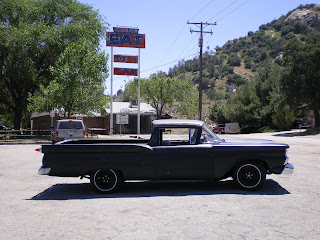
Bay Area Ranchero Meet-up Sunday, October 15th
We are planning to meet-up in the parking lot of the Alameda, Calif. Swap Meet. http://www.turnkeyprod.com/showdates.html
Contact me for more info.
info@thenetworkgirl.com
Sunday, October 15, 2006


Saturday, October 14, 2006
Northern Cali Rancheros 1st crusie in, Alameda Ca 10/14/06

I ended up hosting the 1st No Cal Ranchero meet-up at the Alameda Naval base. It wasn't my intital idea but I ran with it. We were suppose to meet at the Alameda Swap meet but apparently they cancelled the event and only the vendors knew. I decided to stick it out and host the event in my work parking lot anyways. We had about 6 Rancheros that came and went. There was about five us who stuck around and enjoyed the BBQ. And people who drove from as far as Davis / Santa Rosa to be there. It was funny that we had a lot of people drive in to the lot thinking we were the swap meet.
Rods and Wheels has hosted some shots for us and we do all believe this is the beginning of a good thing.
Rods N Wheels
My Event Photos
Tuesday, October 10, 2006
One Door Done, hardware works; another to go...
I was graced with some wonderful assistants today and one of my doors now locks and closes with the orginal hardware.
This is really a great project I have taken on. Some were a little skepticle at first unsure why the heck I would do such a random thing like purchase a project car. But being outdoors, getting dirty and meeting wonderful talented people - who wouldn't want to do it?
I am excited to take on each little project. I might not know how to do it like the pros but by working with people, asking questions and just going for it I am learning a lot.
Its like being back in school and its giving my brain a healthy work out.
This is really a great project I have taken on. Some were a little skepticle at first unsure why the heck I would do such a random thing like purchase a project car. But being outdoors, getting dirty and meeting wonderful talented people - who wouldn't want to do it?
I am excited to take on each little project. I might not know how to do it like the pros but by working with people, asking questions and just going for it I am learning a lot.
Its like being back in school and its giving my brain a healthy work out.
Sunday, October 01, 2006

Rust and Power Tools
Yesterday, I scraped off rust from the inside of my roof with a wire brush and wiped it down with paint thinner for any extra oils and dirt. And, yes my arms hurt a bit the next day.
Today I pulled out my dads old overalls, bandanna, ball cap worn backwards, face mask and safety goggles (had a doctors face shield/mask but went with goggles but they fogged up a bit) and set-out to use the "Eastwood Rust Encapsulator Black Aerosol 16 oz. Item No. 16060 Z" on the inside of my roof. I considered using "POR-15" but considering the application being upside down I went for the Aerosol.
Before the application I lined the inside of my car with a plastic drop sheet, I should have went to the store to get painters tape but I used what I had on hand a box of binder clips which actually worked out perfectly (pictures will be posted later).
The spray went on really well! By the time I left it looked like it would dry evenly and only need one coat. I managed to get one smudge of paint on my face, unfortunately some up my noise the mask that I had did not keep the particles out, even being outside the fumes were definitely getting me high. So as more painting is needed I will get a better mask.
This took me very little time so I went back to the door hardware project. Empowered with a door handle removal tool certain things became much easier. I was only out done today because of my power tool! I got a Ryobi 7v which is not going to be beefy enough to get me thru a day since I don't currently have power right near the vehicle. I got about 3-screws on the door panels that are beyond screwing out naturally. I was able to use a drill bit (after breaking one) to get the first one out. If I wasn't so intent on moving this part of the project along I should probably go out and buy a hole saw but than I got to think about sizes etc. It appears I made it past the threads with no problem and if the other one's don't work out well these parts can be welded down because they don't need to come off again in my life time.
PS. I learned that 'Deep Woods Off' gets POR-15 off skin. I am sure I will end up using POR-15 on other parts and I will try that if my paint gear doesn't protect me.
PS. I learned that 'Deep Woods Off' gets POR-15 off skin. I am sure I will end up using POR-15 on other parts and I will try that if my paint gear doesn't protect me.


Saturday, September 16, 2006
Part of this...is discovering who "Nameless" is
Part of this adventure with 'Nameless' is to discover who she is or really who she wants to be. Now I really thought when I got this car it would sit for a long time under a cover but I don't think that is going to happen...things are just happening in a way that won't allow it. I have been looking around on line to find something that clicks in regards to where she can go - there is 100% restorations, mild custom approaches and going Rat Rod.
In my own life I am a mix of many things, a practical princess, minimal accessories with single focal points, few cool things to keep people guessing and all about black. Now in my mind 'Nameless' chose me out so she got to like that style.
This picture totally jumped out at me today:

This one jumped out at me yesterday:

But I do respect 'Nameless' for what she is already with the Rat Rod style of the red rims and white-wall etc. I think it will be a little of this and a little of that to make her unique unto herself.
In my own life I am a mix of many things, a practical princess, minimal accessories with single focal points, few cool things to keep people guessing and all about black. Now in my mind 'Nameless' chose me out so she got to like that style.
This picture totally jumped out at me today:

This one jumped out at me yesterday:

But I do respect 'Nameless' for what she is already with the Rat Rod style of the red rims and white-wall etc. I think it will be a little of this and a little of that to make her unique unto herself.
Saturday, September 09, 2006

Wednesday, September 06, 2006
More Surprises!! Craiglist Parts Score.
So this really amazing thing happened Friday night. Someone forwarded me an ad from Craigslist. I didn't recognize the email but the ad was for parts for a 1959 RANCHERO!! I immediately called the person who placed the ad because there was a few things I needed. I scheduled an appointment the next day. Was in SF Saturday night and stayed up too late but was totally excited to wake up and go get my parts. The gent selling the parts was a very gracious car enthusiast/mechanic for pre-72 cars. He had purchased the Ranchero to find too much of it was rusted out for a restoration. I totally lucked out in many regards with extra items he threw in just to get them out of his garage but also because another buyer didn't show to buy all the steering/power steering parts! I loaded what would fit in my car and made a second trip tonight. Once again I am amazed by this wonderful car community.
Friday, September 01, 2006
WANTED: PARTS LIST/TO DO
- Radiator (kinda got it! 7/15, from 59' Edsel - needs to be re-cored)
- Fuel Pump (got it!)
- Steering Wheel (got it! 7/15)
- Gauges (Tack etc.) (got 2 now, 9/17 got one with fuel gauge)
- Ignition switch (check! got it from a friend of 'Nameless')
- Battery Tray (got it! 7/15)
- Battery (got it!)
- Ashtray (got it! 7/15)
- Windshield wipers - all parts needed. (got it! 9/17)
- Finish Pop-locks (scratch that got all new doors)
- All Door Hardware - latches etc. (got it! 9/17)
- Front Grill (custom made on the way...)
- Rear Bumper (got it! 7/15)
- Side Mirrors ( got it! 7/15 - extra got in the mail 8/24)
- Tail-light Lense (8/24 got in the mail! from a friend of 'Nameless')
Tuesday, August 01, 2006
A special surprise today! Ranchero Parts Gifted
I got a special surprise today in the mail from a Birch Bay Cowboy - a taillight lens, a back-up light and 2-fender mirrors for the 59. I am delighted and inspired by the warm welcome I have received into the Ranchero family. A warmth that seems to be prevalent with all the enthusiasts I have interacted with a cross the country.
Maybe the world would be a better place if more people drove 'classics'.
I use to have a 69 Overlander - Airstream (I cried the night I sold her and wished today I kept her)... but I felt that same sense of community. And as one of the youngest owners that I bumpt into at twenty something of age it was a great feeling that age didn't matter either.
For me personally and maybe for others I appreciate the sense of history it offers... a connection to a time past and lives past that seems more tangible than 'this' world that seems to be as disposable as a Big MAC box and tastes just as bad going down. With very few real opportunities for human connections today its ironic that some aged steal could create such a spark between people.
A special someone in my life also introduced me to the world of VW Vans and the 'hand wave' that almost all of them offer in passing...it may transcend into other breeds of cars too but its just another sign of humanity behind the wheel...
Maybe the world would be a better place if more people drove 'classics'.
I use to have a 69 Overlander - Airstream (I cried the night I sold her and wished today I kept her)... but I felt that same sense of community. And as one of the youngest owners that I bumpt into at twenty something of age it was a great feeling that age didn't matter either.
For me personally and maybe for others I appreciate the sense of history it offers... a connection to a time past and lives past that seems more tangible than 'this' world that seems to be as disposable as a Big MAC box and tastes just as bad going down. With very few real opportunities for human connections today its ironic that some aged steal could create such a spark between people.
A special someone in my life also introduced me to the world of VW Vans and the 'hand wave' that almost all of them offer in passing...it may transcend into other breeds of cars too but its just another sign of humanity behind the wheel...
Monday, July 10, 2006
DAY 1 - Nameless is Decoded
I spent from 4:30pm-8:00pm with 'Nameless' she told me a lot and I have so much info from investing the time that I need to sort through and type it up for reference. MUCH GOOD NEWS! She is a beauty under her skin.
To start here is the data plate info: Decoder Ring
C: engine code - 292CID, 2bbl. carburetor, Y block
9: model year - 1959
R: Assembly plant - San Jose (that's cool she is a local girl!!)
F: Body style code - Ranchero
186754: consecutive unit number
Body: 66C - 1959 Ranchero
Body Color: see attached picture
C - Wedgewood Blue
E - Colonial White
Z - Platinum
Trim: 39 - "Radiant Blue sof-textured vinyl bolster and blue Shantung
pattern vinyl"
Date: 01 G - July 1st
Trans: 4 - Cruise-o-matic, non over-drive
Axle: 3 - 3.70:1 ratio
Wow! that sounds cool what is
Cruise-O-Matic
The story of Day 1 is to be continued after I shower and eat BUTThe original Cruise-O-Matics used a torque converter and planetary gearsets, giving three forward speeds plus reverse. In some applications, Ford offered a dual-range option allowing the driver to start in either first gear or second gear.
Ford dropped the "Cruise-O-Matic" tradename during the 1970s; in the 1950s and early 1960s promoting the automatic transmission as a feature was a standard practice among automakers as they were relatively new. By the late 1970s most cars had automatics as standard equipment and there was no reason to especially call attention to them. The transmissions were marketed as the Merc-O-Matic when installed in Mercury vehicles.
I am happy with my first day under the hood (which I was able to get to close) it was more productive than most of my work day. Our company server went down - the burning smell led them to the problem and than the internet went down which no one could figure out. I was VERY happy to spend time with 'Nameless' after all of that, picking and looking around it was wonderful how it all made sense.
Sunday, July 09, 2006
Online Ford Parts Companies
Auto Krafters Online:
Whether it's restoration, restomod, or keeping your favorite daily driver on the road, your goal is our goal, the preservation of Classic Fords with some of the finest quality parts and service in the industry.
Personal Note: My dad's old kindergarden friend, Bob suggested this company and he still has the same '70 ranchero' that he had from when I was a kid. I had not talked to Bob for years since my dad had passed on a long time ago but my sister had been talking to him recently and after I bought the 59' Ranchero and was talking to my mom she said that 'I think Bob had a Ranchero'. So I called him up after all these years and he was tickled. I told him too, that if I ever get married I would like him to walk me down the aisle and he confirmed my father would have like that. I do plan to keep in better touch with Bob and I am going to send him some car photos.Whether it's restoration, restomod, or keeping your favorite daily driver on the road, your goal is our goal, the preservation of Classic Fords with some of the finest quality parts and service in the industry.
Old Ford Parts, Classic Ford Parts, Antique Ford Parts, whatever you choose to call your Vintage Ford Car or Pickup Truck parts, one call gets them all at C&G! We handle reproduction and NOS parts for Ford and Mercury cars from 1932 to 1972 including Falcon, Comet, Fairlane, Mustang, Galaxies and Rancheros.
Dearborn Classics is an international mail order company that specializes in the manufacture and supply of quality parts and accessories for the Ford Ranchero, Ford Falcon, Ford Fairlane, Ford Galaxie, Ford Torino and Select Mercury models.
ordered free catalogue 7/9/06
Dennis-Carpenter.com Dennis Carpenter has been manufacturing Ford restoration products for over 35 years and both he and his company know how to build quality parts.
Dennis Carpenter Reproductions has deliberately developed a reputation for manufacturing original style Ford restoration parts that are made to fit and look exactly like the originals.
MAC's Antique Auto Parts : MAC's is the place to obtain Ford auto parts for any old Ford. MAC's is a full-service mail order company selling auto parts for 1909 through 1970's Ford antique and classic autos. Whether your part needs are for an old Model T Ford, Model A Ford, Early V8, Ford Truck, Thunderbird, or any antique or classic Ford, Mercury or Edsel automobile from 1909 through early 1970's, MAC's is your one stop source for classic Ford auto parts.
More listings on the way...
What Does a Car Radiator Do?
Article From WiseGeek:
To understand what a car radiator does, it might help to understand the nature of the internal combustion engine it protects. A car's engine has numerous moving parts, and where there is movement there is friction. Friction creates heat. Motor oil is pumped throughout the engine block to provide some lubrication, but it isn't enough to overcome all of this excess heat energy. As a result, parts of the engine become boiling hot as part of normal operations.
This is where the radiator system comes into play. The engine block must be kept relatively cool to avoid serious problems like overheating and seizure. If the pistons cannot slide freely in their cylinders due to excessive friction, they will eventually snap and cause total engine failure. To prevent this from happening, a mixture of water and anti-freeze is pumped through chambers in the engine block to absorb the excess heat and draw it away from vital areas.
When this superheated engine coolant exits the engine block, it returns to the radiator through a large rubber hose. A car's radiator is designed to maximize surface area through a significant number of internal folds and chambers. As the hot engine coolant moves through these nooks and crannies, excess heat is drawn out through the walls of the radiator. An electrical or belt-driven fan may force cooler outside air through the radiator to accelerate this cooling process. As the car moves, the front of the radiator is also cooled by the outside air coming through the car's grill.
By the time the superheated engine coolant has made its way through all of the chambers of the radiator, it should be cool enough to make a return trip through the engine block. However, if the coolant flow should be reduced by a blockage or loss of fluid, the engine block will not be cooled down and the remaining engine coolant will boil over. This is why maintaining a full coolant level is so important, especially during hot weather or long drives.
A radiator does not contain any electronic parts of its own -- special sensors register the temperature of the coolant as it exits the radiator. Engine coolant does not have to be especially cool in order to be effective, so there is usually a wide range of temperatures considered to be within normal parameters. If anything goes wrong with the radiator itself, such as a leak or broken hose, the operating temperature of the car can reach a dangerous level within minutes. The engine must be allowed to cool down naturally before the vehicle can be driven safely to a mechanic.
Saturday, July 08, 2006
Whats so HOT about Radiators?

Well I am finding that my first needed part isn't just sitting at the local 'AutoZone' though they do have all the hoses etc.
I have done some online research and found that 'Dear Born Classics' has a 3-row for $310.95
I contacted a Radiator Fabrication shop in Sacramento 'JB Radiator' and for the amount of money 'Dear Born' wants I should definitly hold out to see what they can offer me, perhaps even a customized 4-row...
I also had tried some local Radiator shops but they could only do something if I had the radiator and it needed to be repaired but that is not the situation - it doesn't have one, it was parted out before I got the car.
The next option is to spin the wheel of luck and visit local pick and pulls for either a 59' Ranchero or a 59' Fairlane but thats certainly going to require more time with no guarantee. But I do plan to go scouting around when I got a chance and get to know the people who run the places and hopefully get them to give me a call if a beauty falls into their junkyards.

The History of the Ranchero
Ford Ranchero
From Wikipedia, the free encyclopedia
The Ford Ranchero was a car/pickup truck combination vehicle produced between 1957 and 1979 by the Ford Motor Company for the North American market.
It was the first postwar American vehicle like this from the factory and did well enough to spawn a competitor from General Motors, the Chevrolet El Camino.
In Europe, car-based pickup trucks have been more common over the years from a variety of manufacturers, but the American versions are probably the largest and most powerful produced.
It was also Elvis Presley's favorite car.
1957-59

Between 1957 and 1959 the Ranchero was based on the full-size Ford Fairlane platform. There were two models available, a utilitarian standard model, marketed to traditional pickup truck buyers such as farmers, and the Ford Ranchero Custom which picked up most of the options and accessories available on the Ford Fairlane line, including stainless steel bodyside mouldings and two-tone paint. Both standard and Custom could be ordered with any engine available for the Fairlane, all the way up to the 352 in³ (5.8 L) Thunderbird Special. In Canada, the Ranchero was also available in the Meteor line-up.
[edit]
1960-66
In 1960 the Ranchero became much smaller, becoming based on Ford's compact Ford Falcon. Ford believed the market wanted a more practical vehicle, one much smaller, lighter and cheaper than a full-size pickup truck, and indeed the Ranchero sold well in this incarnation. The standard powerplant was an economical 144 in³ (2.4 L) straight-6 (at 30 mpg, this is as good as most modern vehicles). In 1961 the 170 in³ straight-6 was offered, and in 1963 the optional 260 in³ V-8 was offered in addition to the 144 and 170.
The Ranchero evolved along with the Falcon in 1964, becoming just a little larger along with its parent and using the same body style for 1964 and 1965. In 1965, the 289 in³ (4.7 L) V8 was offered.
1966 was a one-year model, as the Falcon evolved again; this would be the last year that the Ranchero was based on the Falcon platform.
[edit]
1967

1967 saw another radical change for the Ranchero, as Ford shifted it to the larger platform (at that point, the Ford Fairlane). This was a well-received vehicle, with clean, straight lines, dual stacked headlights, and plenty of power; engine options started with a 200 in³ (3.3 L) straight-6 and went up to a 390 in³ (6.4 L) FE-series big-block V8 giving 315 hp (235 kW).
[edit]
1968-1971

1968 saw the Fairlane supplemented by the Ford Torino, and the Ranchero became a Torino-based vehicle. Overall, the new Ranchero was bigger and more squarish then before. Engine choices included 2 six cylinders and several V8 choices including the standard 302 and the sporty 390. The powerful 428 Cobra Jet was a mid-year option. Like it's Torino counterpart, the Ranchero could be had with almost any & all options including A/C, buckets seats, optional wheels, & even a vinyl top. The 1969 Ranchero saw slight cosmetic changes, but overall was the same truck as the previous year. One notable option was the introduction of a Ram-Air 428 Cobra Jet V8.
1970 saw another face-lift for the Torino line. Both the Torino & Ranchero featured a shallow-pointed grille and front end with smooth, somewhat more curvaceous lines. Three models were available - the standard Ranchero, Ranchero 500, and Ranchero GT. Like in previous years, all Torino options could be ordered, including the Ram-Air 428 Cobra Jet engine (7 L) with a slightly different 'Shaker' hood scoop borrowed from the Mustang. Also available was a stylish grille that featured hide-away headlights as well as a 3rd hood with an oversized scoop which was standard on Torino GTs. Through 1971 the Ranchero followed the changes in its parent model, including the availability of Ford's new 429, even in Super Cobra Jet form.
[edit]
1972-1976
1972 saw a radical change in the Torino and Ranchero lines. The sleek & pointy look of the previous year's model was replaced with a larger & heavier design. Most prominent was a wide, gaping 'fishmouth' grille and a new body-on-frame design. There were 3 models available; the standard 500, the stylish Squire, and the sporty GT. Engines choices included a 250 six-cylinder and a selection of V8s that ranged from the standard 302 to the Cleveland series 351 & 400 and a larger 385 series 460. The performance oriented 429 was also available. However, all suffered from lower compression ratios to better meet new emissions standards. The 351 in³ (5.75 L) Cleveland could still be obtained in tuned 4-V Cobra Jet form as well as in a milder 2-V version. A 4-speed manual transmission was available on certain GT models. The 1973 Ranchero saw a redesigned front-end to meet new Federal Standards for front impact protection. Aside from slight cosmetic differences, the Ranchero would remain basically the same until the Torino's final year, 1976.
[edit]
1977-1979
With the Torino ending production after 1976, the Ranchero needed a new platform. This was found in the somewhat unlikely guise of the Ford Thunderbird personal luxury coupe, which was undergoing a reincarnation that year also, and sharing features with that year's Ford LTD II full-size car. The same three models available since '68 were still offered, and the Ranchero could be ordered in quite luxurious form. Engines fitted went up to the 400 in³ (6.6 L), a small-block despite its greater cubic capacity than some big-blocks.
Production ceased in 1979. Cars were getting smaller, and the increasing restrictions on a car-based pickup truck made such a vehicle less and less attractive. Meanwhile, light trucks had to meet much less stringent requirements for emissions and fuel economy. Ford saw the way the market was going and decided that light truck sized pickups were the way ahead.
[edit]
Today
Rancheros are reasonably collectible, though they are nowadays often overlooked in favor of the later-arriving Chevrolet El Camino, which stayed in production a few more years. Die-cast Rancheros are almost non-existent compared to the 1968-1973 El Caminos. Most desirable are the early years, up through 1966. In some areas such as the Pacific Northwest, the LTD-II based 1978 and 1978 Rancheros are the most common, even more so than the late 1970s El Caminos, because perhaps the angular nose looks "right" for the pickup body. Australia continues to make Falcon-based pickups, called "utes", but these are lamentably not imported into the US.
The idea of a car-based pickup remains an attractive one, and is an illustration of how favorable treatment for light trucks over cars by United States regulations skews the marketplace. There are many Ranchero and El Camino owners, indeed, who stopped buying new vehicles when those models were discontinued. Recently there has been more interest in producing such vehicles again, including the Subaru Baja which is a 4-seat car with a pickup bed instead of a trunk.
Tuesday, July 04, 2006
Monday, July 03, 2006
Craftsman Tool set - Right of Passage
Ok, so I got a decent size 'Craftsman' tool set and went to get something out of it today to find that everything was bundled up in plastic bags.
Thought I would just put it together before going to bed tonight and found there was very little reason why some stuff was in one bag and other pieces in the other...plus, trying to read the slot names...
ha!ha! is this some odd sort of 'right of passage' -
thee who completes the kit will service their way to freeing himself from the plastic box in the near future by going out and buying a tool box with trays.
And you know one false move picking up the plastic case and everything will fall out! I haven't finished putting it together and the inventory looks a little off (not sure if that happens) but I would almost pay some kid to do this for me.
But on a positive note I was happy to find yesterday that I had most of the other tools I needed already buried away in my closet. Except for the Volt Meter which I also had to buy with the 'Craftsman' set. I have been an odd tool hoarder over the years, not knowing why I kept them but now I am glad I did.
Saturday, July 01, 2006
Whats the diffrence between radiators...
The jury is still out on this but there is recommendations between 3-rows and 4-rows. I am still researching this...
Here is some Tech info comparing radiators.
"Dual row radiators and heater cores have a greater heat rejection capability than single row, but to utilize the higher capability stronger fans must be used to overcome the airflow resistance. Stronger fans make more noise and it was found that with an upper limit of 34 db(A) there is no way to achieve higher performance using a dual row core similar to those tested. Some may ask: What is a radiator’s ‘rating’? The answer is ‘it depends’. Specifically any ‘rating’ will, indeed must, define the flow rates on both the air and liquid sides and the temperature difference between the two sides. All of the thermal resistance and dissipation graphs above describe the ‘ratings’ of these radiators, but the air side flow rate is not known, only the air source (the fan) is held constant. Putting a more, or less, powerful fan on the radiator would necessitate new curves to define its ‘rating. There is no single value that describes a radiator’s ‘rating’ without also stating the flow and temperature conditions."
Nothing to do with Nameless but MOPAR?
I have been hearing the word 'MOPAR' drop from people's lips like a house hold name, like oreo's..MOPAR has nothing to do with Ranchero's but it is an interesting enough word and car term that it seemed worth taking the time to look it up:

"Sometime in the 1930's to early 1940's Chrysler Corporation looked into consolidating the parts divisions of all their brands -- Chrysler, Dodge, Plymouth, DeSoto, Imperial etc. -- into one division.
Thus the Chrysler Corporation Mopar (MOtor PARts) division was created. Parts used on ANY of the brands came in boxes branded with the Chrysler MOtor PARts logo. "
"Sometime in the 1930's to early 1940's Chrysler Corporation looked into consolidating the parts divisions of all their brands -- Chrysler, Dodge, Plymouth, DeSoto, Imperial etc. -- into one division.
Thus the Chrysler Corporation Mopar (MOtor PARts) division was created. Parts used on ANY of the brands came in boxes branded with the Chrysler MOtor PARts logo. "
NOS for Nameless?, NO
Another term :- "NOS" / "New Old Stock" / new ie. "never been used". But they are old. Manufactured back when the car was new. Certainly not the way to go with the 59' but I am seeing a lot of 70's Ranchero enthusiasts going that route.
The Goods on 'Nameless'
It was great spending some quiet time with 'Nameless' today.
I have 2-pages of notes which I will translate in detail later...but to get started...I wrote down anything that had a name or number.
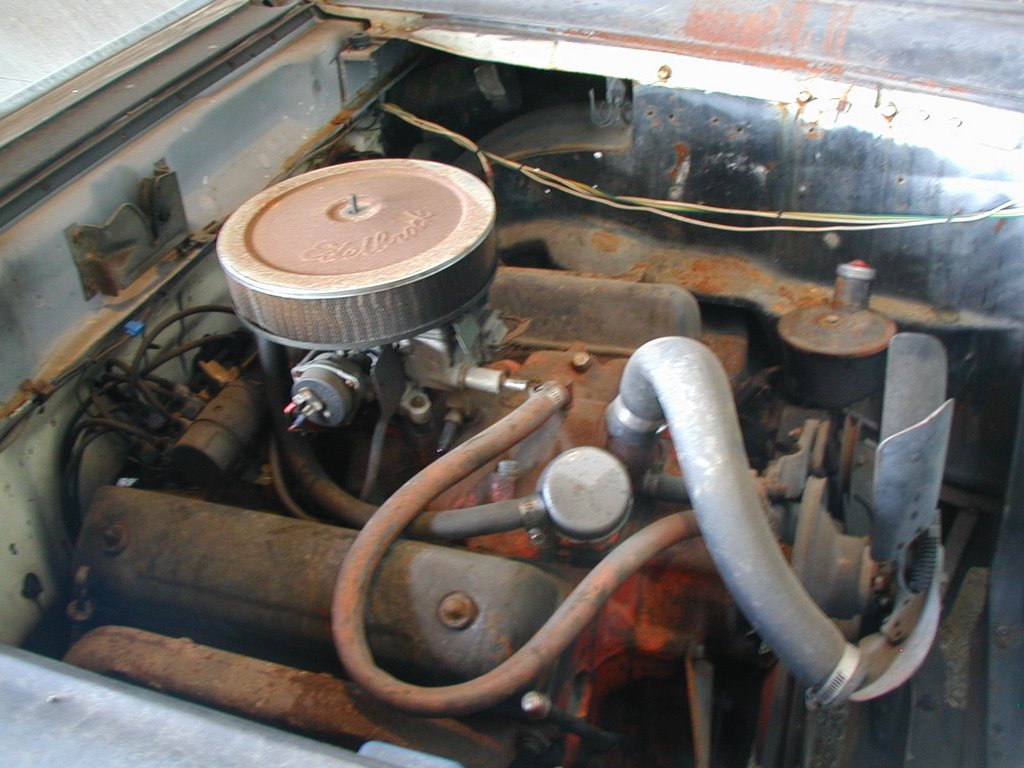
It sat in a storage for at least a year and is over 50 years old so I Lubed up the moving parts. Added some oil for the 'test' to see if the engine would turn over and was not seized. ...I was able to fiddle with the hood a bit and lube it up and got it close and open with the pulley inside the car. The fan for the radiator was not turning so I lubed it up and that loosened it up and than I discovered a bad washer that should be replaced but it now turns freely. I pulled the pieces that were left on the rear tail light and straightened out the plate that was all bent. The damage from the accident will make this one a difficult task and I may rig up a temporary solution just to keep the cops happy till it can be done right.
It sat in a storage for at least a year and is over 50 years old so I Lubed up the moving parts. Added some oil for the 'test' to see if the engine would turn over and was not seized. ...I was able to fiddle with the hood a bit and lube it up and got it close and open with the pulley inside the car. The fan for the radiator was not turning so I lubed it up and that loosened it up and than I discovered a bad washer that should be replaced but it now turns freely. I pulled the pieces that were left on the rear tail light and straightened out the plate that was all bent. The damage from the accident will make this one a difficult task and I may rig up a temporary solution just to keep the cops happy till it can be done right.
Has:
Clock
Radio (TBD if works)
Heater / Gauges
Hoses and Fan for radiator
Aif Filter: PZA170056S21083 (Canada)
Radiator Mounts to frame " between mounts 26" x 11"
Holley
Echlin VR 428 Voltage Regulator
Cornell 855 Ties P215175R14 - All 4 tires have great tread!
SJ85808 - part TBD right drivers side corner
EBV85942 - radiator hose attached to part
5780796 - number on engine behind fan and their was a symbol inside a circle.
It was hard to read the numbers so I grabbed some paper and a pencil and ran over it - it made it a little easier to translate.
By the time I had this all noted. One of 'Nameless' new friends stopped by. He was very excited about the car and generally a Chevy man but 'Nameless' charmed him and he really appreciated her rear end. A few other items he added to the 'has' list: Painless Wiring Harness, Fuel Pump - electric is set-up for already / Vacuum lines tapped up, 7 springs on rear, 3-speed, Ford 9"
He also noted that what I thought was just PAINT OVER THE TRIM was Fiberglass Bondo OVER THE TRIM which I really can't believe they did over the trim - they should have taken it off!
And he noticed the threads on the steering wheel piece were messed up a bit...When the car got towed over behind a pick-up I was given a vice grip to steer with and it may have messed things up because it roughed up the threads for the steering wheel - hopefully not to bad.
He did the 'test' to see if the engine would turn over and it DID! Yeh, that is a good thing and with the proper tools the 'test' wasn't as hard as I thought it was going to be - 'turning over' seemed like a big to do. More on the how to later...
He also noted that what I thought was just PAINT OVER THE TRIM was Fiberglass Bondo OVER THE TRIM which I really can't believe they did over the trim - they should have taken it off!
And he noticed the threads on the steering wheel piece were messed up a bit...When the car got towed over behind a pick-up I was given a vice grip to steer with and it may have messed things up because it roughed up the threads for the steering wheel - hopefully not to bad.
He did the 'test' to see if the engine would turn over and it DID! Yeh, that is a good thing and with the proper tools the 'test' wasn't as hard as I thought it was going to be - 'turning over' seemed like a big to do. More on the how to later...
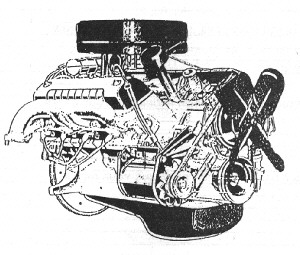
The Engine - 292 V8 Small/Big Block
VIN Code: C
292 cid (4.78 litre)
Maximum hp: 200 @ 4400 rpm
Maximum torque: 285 ft-lb @ 2200 rpm
Minimum compression pressure at cranking speed (lbs): 160
8.8:1 Compression Ratio
3.750 x 3.297 Bore/Stroke
2-bbl Ford carburetor
Fuel: Regular
Carburetor fuel level: 0.910 inches below machined surface
Float setting, dry: 0.450 inches from top surface to top of float
Fast idle cam adjustment: 0.008 - 0.016 inch clearance between cam and adjust screw
Firing order: 1-5-4-8-6-3-7-2
Distributor rotation (viewed from above): Counter-clockwise
Cylinder numbering (front-to-rear, viewed from front) Left: 1-2-3-4 Right: 5-6-7-8
18mm Champion spark plugs, 0.035 gap
Cam Angle (degrees): 26 - 28.5
Breaker Contact Gap (inches): 0.014 - 0.016
Breaker Point Arm Spring tension (ounces): 17-20
Centrifugal Spark Advance (degrees): 0 @ 400 rpm
Centrifugal Spark Advance (degrees): 0 - 1 @ 450 rpm
Centrifugal Spark Advance (degrees): 1 - 2 @ 500 rpm
Centrifugal Spark Advance (degrees): 4 - 5 @ 750 rpm
Centrifugal Spark Advance (degrees): 14 - 15.5 @ 2000 rpm
Vacuum Spark Advance @ 1000 rpm (degrees): 0 - 3 (6.5 inches of vacuum)
Vacuum Spark Advance @ 1000 rpm (degrees): 5 - 8 (10 inches of vacuum)
Vacuum Spark Advance @ 1000 rpm (degrees): 9.5 - 12.5 (15 inches of vacuum)
Ignition Timing with standard transmission: 3 deg BTDC
Ignition Timing with automatic transmission: 6 deg BTDC
Idle speed in Neutral with standard transmission (rpm): 475 - 500
Idle speed in Neutral with automatic transmission (rpm): 450
Generator maximum controlled output (Std): 30 amp, 15 volt @ 2525 generator rpm
Generator maximum controlled output (Air Cond): 40 amp, 12 volt @ 2670 generator rpm
Generator brush tension (ounces): 36 - 40
Gernerator rotation (viewed from drive end): Clockwise
Regulator cut-out relay - Close: 12.4 - 13.2 @ 1200 generator rpm
Regulator cut-out relay - Open (Std): 6 - 9 amps reverse current
Regulator cut-out relay - Open (Air Cond): 2 - 6 amps reverse current
Current Regulator - Standard (amps): 28 - 32
Current Regulator - Air Cond (amps): 33 - 37
Voltage Regulator (volts): 14.6 - 15.4 with 5 amp load at 75 degF ambient
Starter motor free running speed: 4500 rpm (85 amps, 12.0 volts)
Starter motor lock torque: 15.5 min ft-lbs (550 amps, 5.0 volts)
Battery cable length - battery to ground (inches): 16.50
Battery cable length - battery to switch (inches): 12.00
Oil Pressure (lbs): 45 - 50
Valve Stem clearance - Intake (inches): 0.019
Valve Stem clearance - Exhaust (inches): 0.019
Valve Timing: Intake valves open at 12 degrees before top dead center
Cooling system capacity - 8-cylinder (qt): 19 (20 if equipped with heater)
Thermostat opening temperature (deg F): 157 - 162 with alcohol-type antifreeze
Thermostat opening temperature (deg F): 177 - 182 with permanent antifreeze)
Average miles per gallon: 13.7
The 1955 FORD 4.8 L - 1964 FORD 292 ENGINE -- BIG/SMALL BLOCK engine configuration includes a Y-block engine. It is in fact a fully-loaded, sizable 4.8L capacity-rich V8. This is a powerhouse automobile piston engine from Ford Motor Company.
According to online sources its history can be traced back quite some time. It was introduced back in 1954 to replace the Ford L-Head engine and was replaced by the Ford FE engine (on larger cars) and the Ford Windsor engine (on smaller cars) in 1962. It was popular and lasted until 1964 in Ford trucks.
It is worthy to note that Lincoln also introduced its own Y-block in 1952. This particular engine iteration lasted until the 1958 introduction of the MEL. Back to the 55-64 Ford 292 engine.
The 292 (4.8 L) Ford engine is versatile and robust and was also introduced in 1955. It was used in the Ford Thunderbird, and some high-end Ford and Mercury cars. This engine was also used in Ford trucks, namely the F-100, through 1963. It is still popular in the aftermarket and engine parts arena.
Other interesting facts regarding this Ford powerplant that is the 292 4.8L engine:
* Ford Australia released this v8 motor as its only option in the 4 door sedan CUSTOMLINE 1955-59 (based on the crown victoria }and its utility based on the same styling as the customline and called a [MAINLINE}
* Part of the Ford Y-block engine configuration family.
* First introduced in the T-bird and Montclair
* All used four barrel carb in 1955, but horsepower varied, but average around 200 depending with manual or automatic transmissions.
* Bore and stroke: 3.75x3.30 in.
* Following years were produce less horsepower, until its' demise in 1964
Friday, June 23, 2006
Subscribe to:
Posts (Atom)